
Old Tappan Bans Short-Term Rentals and Boarding Houses Townwide, Limits Sober Living Homes to Town Center Zone
OLD TAPPAN, N.J. — Old Tappan has banned short-term rentals of 30 days or less and boarding houses in every zone of the borough, and it will allow sober living…
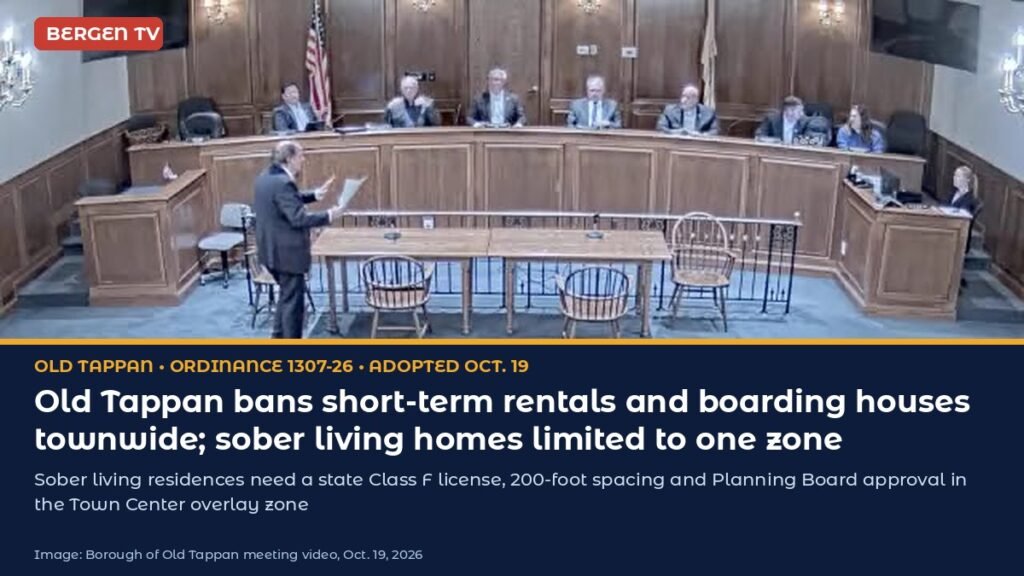
OLD TAPPAN, N.J. — Old Tappan has banned short-term rentals of 30 days or less and boarding houses in every zone of the borough, and it will allow sober living homes only in its Town Center overlay zone, under strict conditions. The Mayor and Council adopted Ordinance 1307-26 on second reading at their Oct. 19 meeting. No member of the public spoke at the hearing.
The ordinance amends Chapter 255, the borough’s zoning code. It was introduced Oct. 5 and takes effect once it’s published, according to its text.
What’s now banned everywhere
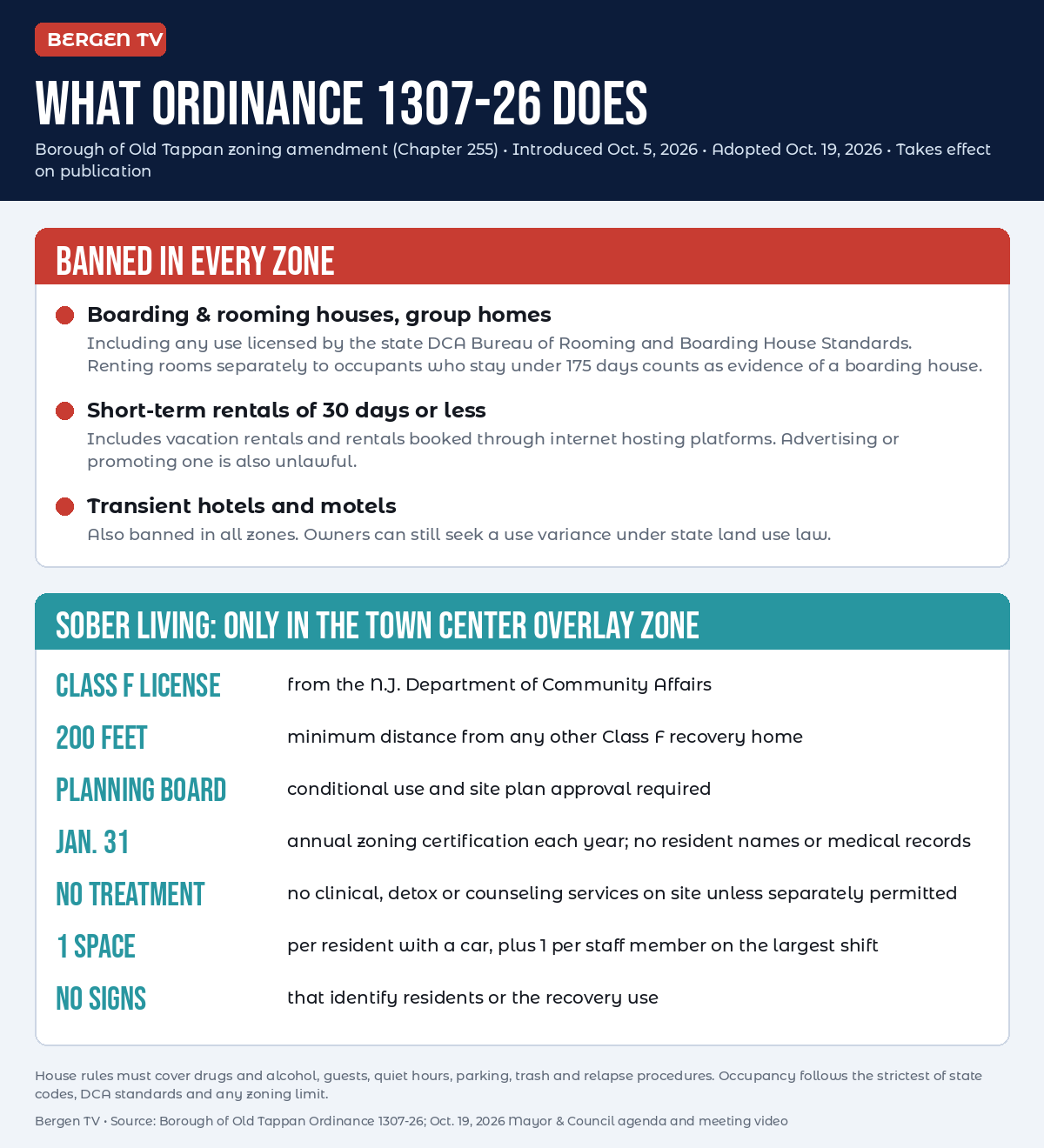
- Boarding houses: That includes rooming houses, group homes and any use licensed by the New Jersey Department of Community Affairs’ Bureau of Rooming and Boarding House Standards. Renting rooms separately to occupants who don’t live as one household and stay less than 175 days counts as evidence of a boarding house.
- Short-term rentals: The ordinance defines these as renting a home, or part of one, for 30 consecutive days or less, including vacation rentals and rentals booked through internet hosting platforms. It calls them a commercial lodging use, not a residential one. Advertising or promoting a rental that breaks the rule is also unlawful.
- Transient hotels and motels that rent for 30 days or less are banned in all zones too.
For short-term rentals, hotels and motels, the ordinance says owners can still apply for a use variance under the state’s Municipal Land Use Law. Old Tappan had already barred boarding houses from its residential RA districts in Ordinance 1286-25.
Sober living homes: one zone, many conditions
The ordinance makes cooperative sober living residences, homes where people recovering from drug or alcohol addiction support each other’s recovery, a conditional use in the Town Center Overlay Professional (TCO-PO) zone. The ordinance says that zone already has a residential component, and that the rules are meant to provide “reasonable accommodation for persons with certain disabilities involving alcohol or drugs.” The ordinance’s townwide ban list also names cooperative sober living residences; a separate section then permits them in the TCO-PO zone as a conditional use. The conditions include:
- A Class F license from the state Department of Community Affairs.
- At least 200 feet from any other Class F recovery home.
- Conditional use and site plan approval from the Planning Board.
- An on-site operator or house manager where state law or licensing requires one, and written house rules covering drugs and alcohol, guests, quiet hours, parking, trash and relapse procedures.
- No clinical treatment, detox or counseling on site unless separately permitted. Peer-support and 12-step meetings are allowed.
- One off-street parking space per resident who keeps a car there, plus one per staff member on the largest shift, unless the board approves less.
- No signs that identify residents or the recovery use, and a local contact person given to the zoning officer, police and fire officials.
- An annual zoning certification by Jan. 31. It can’t require resident names, diagnoses or medical records.
What was said at the meeting
A special counsel the borough retained for the ordinance told the council that “a lot of municipalities now are trying to address this.” He said the borough planners’ 2026 re-examination of the master plan recommended the changes, and that the borough planner’s consistency report found the ordinance consistent with the master plan. He said a constant theme of the borough’s 2006, 2016 and 2026 master plans is preserving single-family neighborhoods. A council member asked what happens if the borough’s definition of a group home differs from the state’s. The counsel said the ordinance covers any use regulated by the state’s rooming and boarding house bureau. The council then adopted the ordinance on a roll-call vote, with every member called voting yes, according to the video.
Later in the meeting, during council reports, members discussed asking the Planning Board and the Environmental Commission to look at whether any Old Tappan properties could host a data center and to suggest wording for an ordinance prohibiting them. A council member said more than 100 towns have passed bans. No ordinance has been introduced.
Sources: Ordinance 1307-26 (Borough of Old Tappan); Oct. 19, 2026 Mayor and Council agenda; Ordinance 1286-25; official meeting video, Oct. 19, 2026.
Do you know of a short-term rental, boarding house or sober living home in Old Tappan or elsewhere in Bergen County? Tell us what we should look into next at bergentv.com.
0 comments
Sign in to comment