
Garfield Ordinance Would Let Police Put License-Plate Cameras on Homes and Businesses — Owners Couldn’t Remove Them Without Police OK
GARFIELD, N.J. — A proposed Garfield ordinance would let the city’s police department place automated license-plate reader cameras on private homes and businesses whose owners agree — and once a…
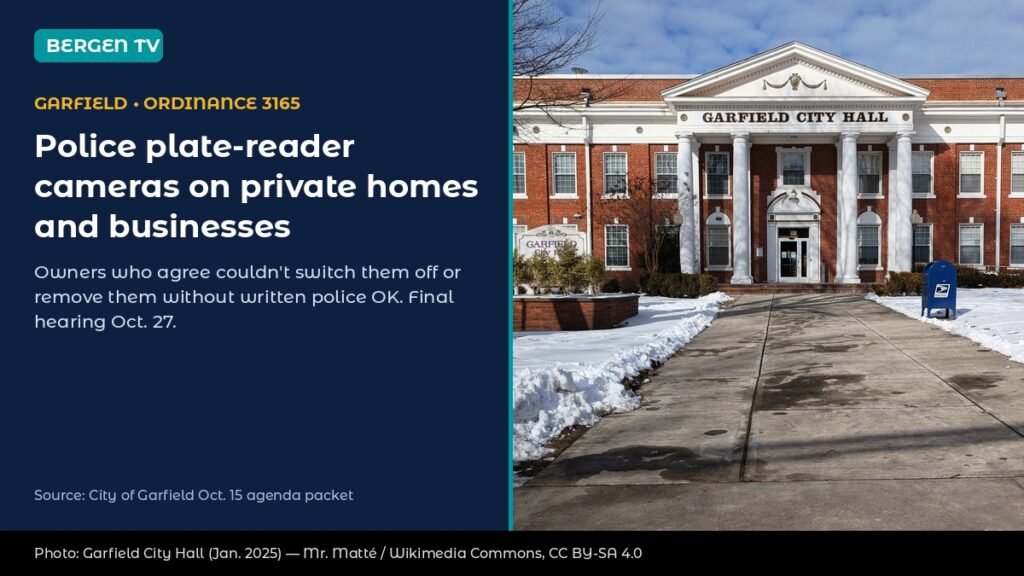
GARFIELD, N.J. — A proposed Garfield ordinance would let the city’s police department place automated license-plate reader cameras on private homes and businesses whose owners agree — and once a camera goes up, the owner could not switch it off, move it or take it down without written permission from the police, according to the ordinance text in the city’s Oct. 15 meeting packet.
Ordinance No. 3165, “An Ordinance Regulating the Placement and Operation of Automated License Plate Recognition Systems on Municipal Property and Within Municipal Rights-of-Way,” was listed for introduction on first reading at the Garfield Mayor and Council work session on Thursday, Oct. 15, 2026. The introducing resolution, R-480-26, schedules the final public hearing for Tuesday, Oct. 27, at 6 p.m.
What the ordinance would do
License-plate readers are cameras that automatically read passing plates and turn them into searchable vehicle-location data. The ordinance has three main parts.
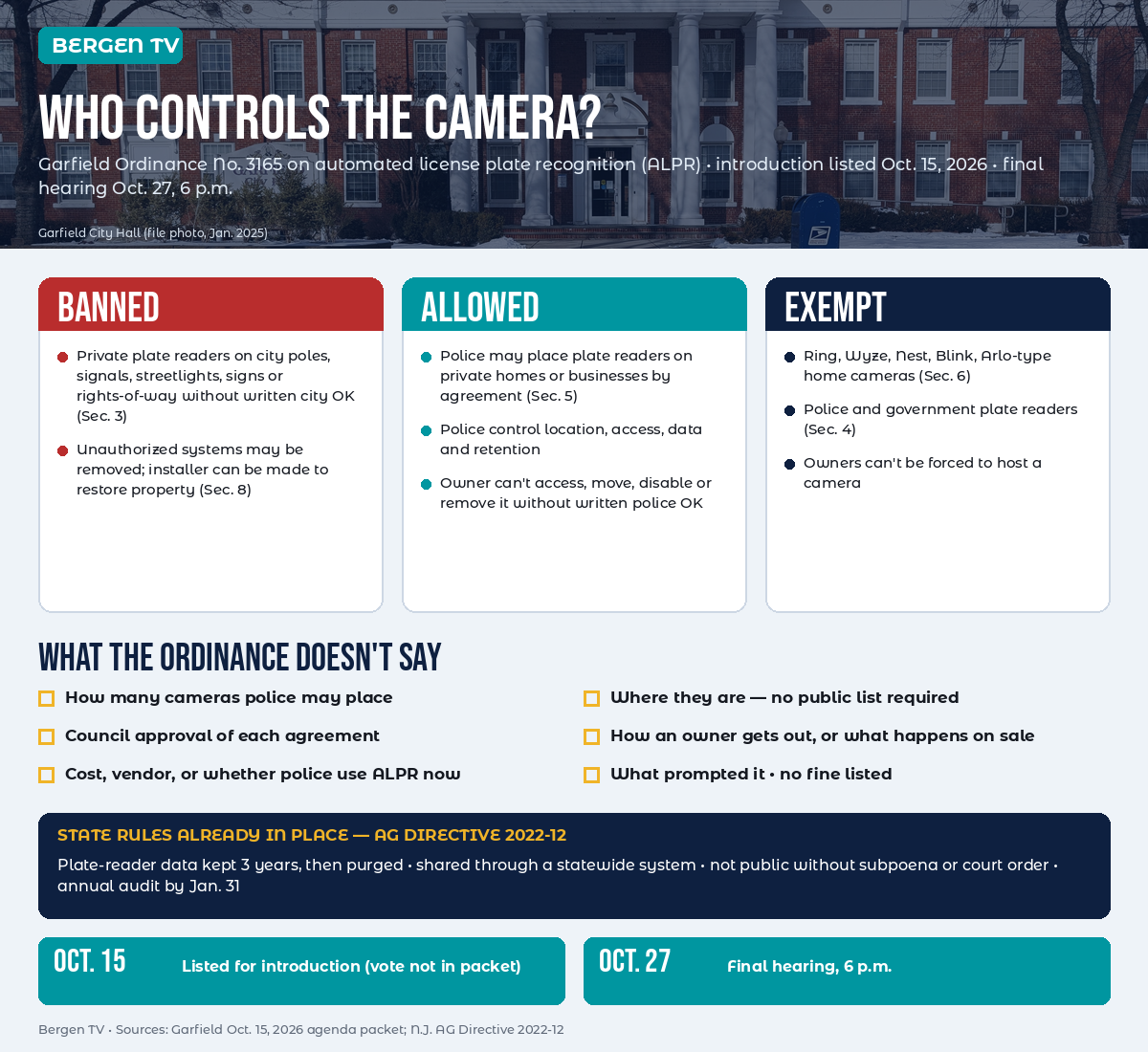
- A ban on private plate readers on city property. No private person, business or organization could install or run a plate-reader system on city property — including poles, traffic signals, streetlights and signs — or in a city right-of-way without express written authorization from the city (Section 3). Unauthorized systems “may be subject to removal,” and the city could make whoever installed one restore the property (Section 8).
- Police cameras on private property. The Garfield Police Department could enter into an “arrangement or agreement” with the owner, tenant or lawful occupant of private residential or commercial property to place a plate-reader camera there (Section 5). The department would decide the camera’s location, configuration, access, data management and retention. The property owner “shall not independently access, modify, operate, alter, relocate, disable, remove, or otherwise control” the camera or its data unless the police department authorizes it in writing. Participation must be voluntary: the ordinance says no owner can be required to allow a camera.
- Home cameras are exempt. Ordinary security cameras such as Ring, Wyze, Nest, Blink and Arlo are not covered, even if they happen to capture license plates, unless they are configured to work as plate readers (Section 6).
Police and other government agencies are exempt from the ban, and any vendor that provides plate-reader services to the city would not gain ownership of, or unrestricted access to, the data just by supplying equipment or software (Sections 4 and 7).
What the state rules already require
The ordinance says police use of plate readers remains subject to state rules, including New Jersey Attorney General Law Enforcement Directive 2022-12. That October 2022 directive, which took effect Jan. 23, 2023, requires plate-reader data and access records to be kept for three years and then purged unless tied to an active investigation or court case. It requires police plate-reader data to be made available through a statewide system that other New Jersey agencies can search. It also treats stored plate-reader data as criminal investigatory records that are not released to the public without a subpoena or court order, and it requires each agency to audit its program every year by Jan. 31.
The directive also says private entities may provide plate-reader data to New Jersey police but cannot receive data owned by law enforcement.
What the ordinance does not say
- How many cameras. It sets no limit on how many plate readers police could place on private property.
- Where they are. It does not require the city to publish a list of camera locations or to report them to the council.
- Who signs off. It does not require council approval of individual agreements with property owners, and no model agreement is attached to the ordinance in the packet.
- What happens if an owner changes their mind or sells. Participation is voluntary, but the ordinance does not explain how an owner leaves an arrangement. It says only that the owner cannot disable or remove the camera without written police authorization.
- Cost and vendor. It names no vendor and no cost, and it does not say whether the Garfield Police Department uses plate readers now or plans to buy them.
- Why now. The “whereas” clauses cite control of city property, public safety and privacy. They do not describe any specific private plate-reader installation in Garfield that prompted the measure.
- Penalties. Enforcement is left to “the appropriate City official, department, or agency as authorized by law.” No fine is listed.
The agenda packet does not record a vote. The introducing resolution shows blank “resolution by” and “seconded by” lines, and the ordinance’s “introduced” and “adopted” dates are blank. Bergen TV has not yet confirmed whether the council voted to introduce it on Oct. 15.
Also on the Oct. 15 agenda
- Water bond: Ordinance No. 3166, a $730,000 bond ordinance for water utility improvements and equipment, with a $34,900 down payment and up to $695,100 in bonds or notes.
- Citywide reassessment: Resolution R-487-26 approves an $833,625 special emergency appropriation for a complete reassessment of real property, to be raised at $166,725 a year in the next five budgets.
- Parking permits: Ordinance No. 3167 would change how restricted residential permit-parking zones are designated.
The governing body is Mayor Everett E. Garnto Jr., Deputy Mayor Kevin Kane Jr. and council members Joseph Delaney, Tana Raymond and Richard Rigoglioso, according to city records. Erin N. Delaney is the city manager and city clerk.
Open questions
- Did the council introduce Ordinance 3165 on Oct. 15, and by what vote?
- Does the Garfield Police Department operate license-plate readers today, and from which vendor?
- Has any private plate-reader camera been installed on a Garfield pole or right-of-way?
- Will the city publish where police-controlled cameras on private property are located?
Residents can speak on the ordinance at the final hearing scheduled for Tuesday, Oct. 27, at 6 p.m. The city’s annual meeting notice says regular meetings are held in the Municipal Building; City Hall is at 111 Outwater Lane.
Sources: City of Garfield Mayor and Council work session agenda packet, Oct. 15, 2026 (Ordinance Nos. 3165, 3166, 3167; Resolutions R-480-26 and R-487-26); N.J. Attorney General Law Enforcement Directive No. 2022-12 (Oct. 21, 2022); City of Garfield 2026 reorganization agenda, 2026 introduced budget and official mayor biography page; City of Garfield 2026 annual meeting notice.
0 comments
Sign in to comment